Businesses are constantly exploring new ways to engage customers, simplify processes, and operate more efficiently. AI voice assistants have emerged as a game-changer—capable of scheduling appointments, answering questions, and delivering personalized recommendations. Far from being a futuristic concept, these tools are helping companies grow and connect with their audiences in meaningful ways.
Table of Content
Major tech giants like Amazon, Google, and Apple have made voice assistants ubiquitous, but a custom voice assistant tailored to your business needs can deliver far greater value. A bespoke AI assistant can reflect your brand’s voice, integrate seamlessly with your business systems, and provide a unique experience that off-the-shelf solutions simply cannot match.
For businesses looking to stay ahead, understanding how to develop a voice assistant is essential. This guide will walk you through each step of the process—from defining the purpose and scope to deploying a fully functional AI assistant—so you can create a solution that genuinely benefits your organization. Whether you’re considering how to create a voice assistant for customer support, internal operations, or sales, this guide provides actionable insights and practical strategies to get started.
By the end of this blog, you’ll have a clear roadmap to develop a voice assistant that not only meets your business objectives but also provides a seamless, engaging experience for your users.

Before diving into technical development, it’s crucial to establish a clear purpose and define the scope of your AI voice assistant. Attempting to build a voice assistant without a well-defined goal can lead to unnecessary complexity, wasted resources, and a product that fails to meet user expectations.
The first step in understanding how to create a voice assistant is determining why your business needs one. Common objectives include:
Clearly defining the goal will guide every subsequent decision, from selecting technology to designing conversational flows.
Next, consider who will interact with your assistant. Is it customers, employees, or both? Understanding the audience helps tailor the language, tone, and complexity of interactions. For example, a voice assistant for internal operations may use technical terms, while one for customers should prioritize clarity and simplicity.
Defining what your assistant can and cannot do is essential. Overloading it with too many features in the initial version can lead to performance issues and a poor user experience. Start with a minimum viable product (MVP) focusing on core functions, and gradually expand capabilities based on user feedback.
Consider questions such as:
By clearly defining the purpose and scope, you lay the foundation for a successful project and ensure your AI assistant aligns with your strategic objectives. This clarity also simplifies decisions regarding technology, training data, and conversational design when you develop voice assistant solutions.
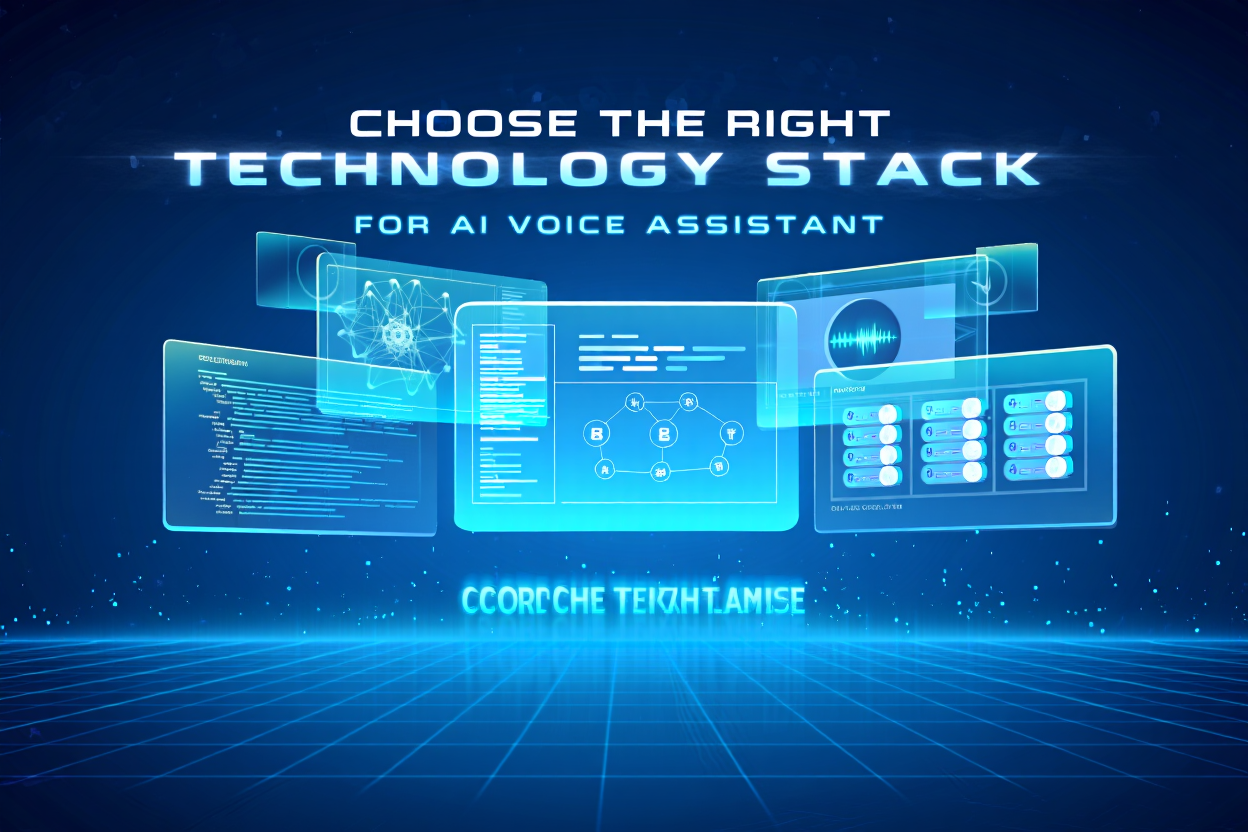
Once you’ve defined the purpose and scope of your AI voice assistant, the next critical step is selecting the right technology stack. The technology stack determines how effectively your assistant can understand users, process requests, and deliver accurate responses. Choosing the appropriate tools and platforms can make the difference between a smooth, efficient voice assistant and one that frustrates users.
To develop a voice assistant, it’s important to understand the key components that form its foundation:
When considering how to create a voice assistant, your choice of programming language and frameworks is critical. Python is widely used due to its robust libraries for machine learning and NLP, such as TensorFlow, PyTorch, and spaCy. Node.js is another popular choice for building scalable, real-time applications and integrating with web services.
Frameworks like Rasa allow developers to build conversational AI systems with minimal overhead, while providing flexibility for customization. Choosing the right framework depends on your project’s complexity, scalability needs, and integration requirements.
You also need to decide where your voice assistant will be hosted: in the cloud or on-premise.
A robust voice assistant doesn’t operate in isolation. To maximize its value, consider integrating it with your existing business systems:
Integrating your assistant ensures it can provide meaningful responses, access real-time information, and support business operations effectively.
When you develop a voice assistant, your goal should be to balance functionality, scalability, and cost-effectiveness. Evaluate tools and platforms based on:
By carefully selecting the technology stack, you set your AI voice assistant up for success, ensuring it can reliably handle user interactions, learn from data, and grow alongside your business.

Once the technology stack is in place, the next step in how to build a voice assistant is designing the conversational flow. A voice assistant’s success depends not only on its technical capabilities but also on how naturally and effectively it communicates with users. A well-structured conversational flow ensures that users receive accurate responses, enjoy a seamless experience, and are guided toward completing tasks efficiently.
Conversational design is the process of mapping out how users will interact with your AI assistant. When you develop voice assistant solutions, the goal is to make the interaction feel intuitive, human-like, and frictionless. Considerations include:
The core of conversational flow lies in understanding user intents—the goals or questions behind each interaction. Begin by:
This process ensures that your AI can handle a variety of queries accurately. Tools like Rasa, Dialogflow, and Botmock help visualize and design these conversation paths.
No matter how well-designed your assistant is, users may ask unexpected questions. Preparing for these scenarios is crucial when you how to create a voice assistant:
While voice is the primary interface, consider adding multimodal support if relevant. This allows your assistant to respond via text, images, or visual cues alongside voice, enhancing accessibility and user experience. For example, a voice assistant in an e-commerce app could verbally describe a product while displaying images on the screen.
Before full-scale deployment, create a prototype of your conversational flow. This allows you to:
Iterative testing is essential in how to make a voice assistant that users enjoy interacting with. Start with a small, controlled set of intents, gather feedback, and gradually expand the assistant’s capabilities.
To illustrate, consider a customer support voice assistant:
By carefully designing the conversational flow, you ensure your AI assistant is not only functional but also engaging, efficient, and aligned with user expectations.
Also Read: Al App Development: A Complete Step-by-Step Guide

After designing the conversational flow, the next critical step in how to develop a voice assistant is training it with data. Training is what enables your AI assistant to understand user queries, identify intents, extract relevant information, and respond accurately. Without proper training, even the most well-designed conversational flow will fail to deliver meaningful interactions.
Training data is the backbone of any AI system. For voice assistants, this includes examples of user queries, phrases, and possible responses. The quality and diversity of your training data directly impact the assistant’s accuracy and reliability.
A well-trained assistant can:
When you develop voice assistant solutions, collecting comprehensive training data is essential. Common methods include:
Combining multiple data sources ensures your assistant can handle a wide range of inputs and scenarios.
Once data is collected, it needs to be annotated—labeling each query with its corresponding intent and entities. For example, in the query “Book a meeting for Friday at 3 PM,” the intent is “schedule_meeting,” and the entities are “Friday” (date) and “3 PM” (time).
Accurate labeling is critical for:
With labeled data, your AI assistant can now learn patterns using machine learning algorithms. Platforms like Rasa, Dialogflow, and Microsoft LUIS provide built-in NLU models that can be trained on your data. During training:
Continuous retraining with new data helps improve performance over time.
A high-performing voice assistant is never truly “finished.” As users interact with it, new patterns, phrases, and requests will emerge. Incorporating these into your training data is essential when you know how to make a voice assistant that evolves with your business.
Strategies include:
When training your AI assistant, it’s vital to handle data responsibly:
Ensuring ethical practices builds trust with users and protects your business from potential legal risks.

Once your AI voice assistant is trained, the next crucial step in how to develop a voice assistant is rigorous testing and refinement. Testing ensures your assistant performs accurately, handles real-world queries effectively, and provides a seamless user experience. Without thorough testing, even a well-trained assistant may fail in practical scenarios, leading to frustrated users and missed business opportunities.
Testing is not just about identifying errors—it’s about validating the assistant’s usability, reliability, and effectiveness. By systematically evaluating performance, you can ensure that your AI assistant meets user expectations and aligns with your business goals. Testing helps to:
When you develop voice assistant solutions, consider multiple levels of testing:
Each type of testing uncovers unique issues and contributes to building a reliable, high-performing AI assistant.
To measure your assistant’s effectiveness, track essential performance metrics:
Monitoring these metrics helps you pinpoint areas that need improvement and prioritize enhancements.
No voice assistant is perfect from the start. Iterative refinement is key when you know how to make a voice assistant that consistently meets user needs. Strategies include:
Continuous refinement ensures that your assistant becomes more accurate, responsive, and user-friendly over time.
Even after deployment, ongoing monitoring is essential:
By combining testing, iterative refinement, and production monitoring, you can ensure your AI assistant not only works but thrives in real-world conditions, providing tangible benefits for your business.
Also Read: How Much Does It Cost to Build an AI Solution in 2025?

After testing and refining your AI voice assistant, the next step in how to build a voice assistant is deployment and integration. This phase transforms your prototype into a fully functional assistant that interacts with real users, supports business operations, and delivers measurable value. Careful planning during deployment ensures stability, scalability, and a seamless experience.
When you develop voice assistant solutions, choosing the right deployment strategy is crucial. The main options include:
To maximize the value of your AI assistant, it must integrate seamlessly with existing business systems:
Effective integration ensures that your assistant can perform meaningful tasks, access relevant information, and provide a unified experience across all business channels.
Security is a critical factor when deploying a voice assistant, especially one that interacts with sensitive business or customer data. Key practices include:
Prioritizing security during deployment builds trust with users and safeguards your business from potential risks.
Once live, your AI assistant should be capable of handling increasing user interactions without performance degradation. Considerations for scalability include:
Regular maintenance is equally important:
Even after successful deployment, continuous monitoring is essential for long-term success when you how to make a voice assistant that evolves with your business:
By carefully planning deployment, integrating with business systems, prioritizing security, and continuously optimizing performance, your AI voice assistant can deliver tangible benefits and become an indispensable tool for your organization.
As AI technology continues to evolve, businesses looking to develop a voice assistant must consider future enhancements and emerging trends. Keeping your voice assistant up-to-date ensures it remains relevant, provides superior user experiences, and stays ahead of competitors.
One major trend is multilingual voice assistants. As businesses expand globally, enabling your assistant to understand and respond in multiple languages can significantly improve accessibility and user satisfaction. When you develop voice assistant solutions, incorporating multilingual capabilities ensures broader reach and better engagement with diverse audiences.
Future AI voice assistants are increasingly incorporating emotional intelligence. By analyzing tone, pitch, and context, assistants can recognize user emotions and adjust responses accordingly. This allows for more empathetic and human-like interactions, which is especially valuable in customer support and healthcare applications.
Rather than waiting for users to initiate interactions, modern AI assistants are moving toward proactive behavior. They can anticipate user needs, offer suggestions, and take actions based on predictive analytics. For example, a voice assistant could remind customers of upcoming appointments, suggest relevant products, or provide real-time updates based on user behavior. Businesses exploring how to create a voice assistant can leverage predictive AI to enhance engagement and operational efficiency.
Voice assistants of the future will increasingly integrate with AI-driven analytics platforms. By analyzing conversations, preferences, and usage patterns, businesses can gain valuable insights for marketing, product development, and customer service optimization. This makes your AI assistant not just a communication tool but also a source of actionable business intelligence.
Emerging trends point toward multimodal AI assistants that combine voice with augmented reality (AR) and virtual reality (VR). This allows users to interact with digital environments more immersively. For example, a retail voice assistant could guide customers through a virtual store, verbally describing products while visually presenting them in AR. Businesses learning how to make a voice assistant can explore these capabilities to create truly innovative experiences.
Future voice assistants will increasingly focus on personalized experiences. By learning user preferences and adapting responses over time, they can provide highly relevant recommendations and tailored interactions. Implementing continuous learning mechanisms ensures your AI assistant remains intelligent, adaptive, and aligned with user expectations.
As AI becomes more pervasive, ethical considerations are critical. Businesses must ensure their assistants are transparent, unbiased, and respectful of user privacy. Following responsible AI practices not only builds trust but also positions your organization as a forward-thinking, ethical leader in technology adoption.
By staying abreast of these enhancements and trends, businesses can ensure that their AI voice assistant continues to deliver value, engages users effectively, and remains a competitive advantage in a rapidly evolving digital landscape.
Building a custom AI voice assistant can transform the way your business interacts with customers, streamlines operations, and leverages data for smarter decision-making. From understanding how to develop a voice assistant to designing intuitive conversational flows, training with high-quality data, and integrating seamlessly with your existing systems, each step is critical to creating a solution that truly adds value.
A well-designed voice assistant is not just a tool—it becomes an extension of your brand, delivering personalized, efficient, and engaging experiences that meet the evolving expectations of users. By investing time in defining the purpose, selecting the right technology stack, and continuously refining performance, businesses can ensure their AI assistant remains effective, reliable, and ahead of the curve.
As AI technology evolves, keeping an eye on trends such as multilingual support, emotional intelligence, predictive capabilities, and multimodal experiences can help your assistant stay relevant and competitive. With careful planning, ethical practices, and ongoing improvements, you can develop voice assistant solutions that enhance productivity, strengthen customer relationships, and position your business as a forward-thinking leader in innovation.
The journey of creating an AI voice assistant may seem complex, but with a structured approach and the right resources, it is entirely achievable. By following the steps outlined in this guide, you can confidently embark on the path to how to make a voice assistant that truly empowers your business.


 Contact Us
Team Up With Us Today For An Unforgettable Service Experience












 Book Free Consultation